






READ OUR RESOLUTION ON THE VALUE OF NONPARTISAN CIVIL SERVICE, PASSED AT THE 2026 LWVUS NATIONAL CONVENTION, HERE!!!
CIVIL SERVICE IN LOUISIANA
In the 2025 regular session of the Louisiana Legislature, a bill was passed to allow the Legislature greater latitude to unclassify civil service positions. The bill passed and will now be a constitutional amendment ballot issue for Louisiana voters to consider. While neither the national nor the state League has a specific position on civil service, the issue has been an issue on which the League has done significant work historically at the national level. It has also been an issue of interest to our Louisiana Leagues, so much so that the theme of our 2025 State Convention on “Serving Democracy: The Value of Nonpartisan Civil Service.” On this page, we provide resources for Louisiana voters to consider on the subject of civil service in Louisiana.
LWV of Louisiana has monitored the progress of this bill over the last year, including legislative hearings in the Louisiana Senate and House. Last spring we penned our own letter to the editor about the bill, and our letter was published around the state in The Advocate. A retired civil servant who provided testimony on the bill in the House, even brought a newsprint copy of our letter to the hearing. Now that’s some legislative presence!
Ours wasn’t the only voice, there have been other letters. In light of this, we think it is important for Louisiana voters to understand the history of our civil service in Louisiana, which has been marred at times by corruption and abuse, but to which lasting reforms have been made to ensure a trained, meritocratic, and nonpartisan civil service in our state.
Letters to the Editor
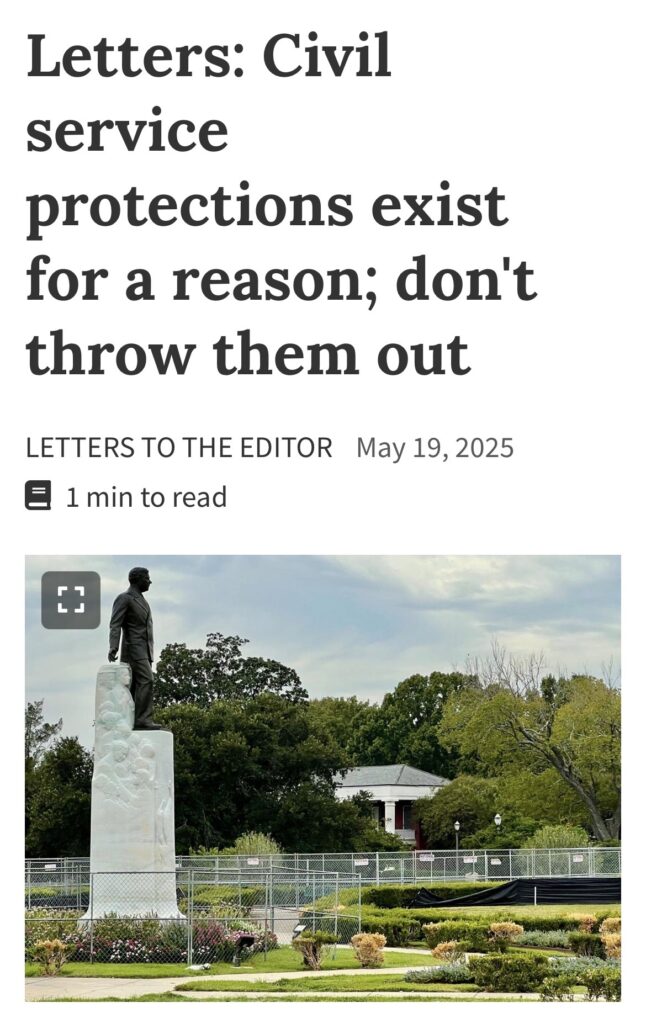
LEAGUE LETTER “Letters: Civil service protections exist for a reason; don’t throw them out“, The Advocate, May 19, 2025.
Information Resources
Louisiana Amendment 1, Legislative Authority to Add or Remove Unclassified Civil Service Positions Amendment (May 2026), Ballotpedia.
Understanding Proposed Constitutional Amendment No. 1, Louisiana State Civil Service.
“Charles Dunbar and Civil Service Reform“, Louisiana State Civil Service, by Becky Cresap, The Bridge, July 2010.
News Coverage
“State Constitutional Amendment coming to the ballot in May“, KNOE, December 10, 2025.
“Louisiana Legislature could get more power over civil service if constitutional amendment passes”, The Advocate, June 13, 2025.
“State employee protections will go before Louisiana voters“, New Orleans City Business, June 13, 2025.
“State employees’ civil service protections in doubt as constitutional amendment advances“, Louisiana Illuminator, June 9, 2025.
“Louisiana state employees could lose jobs under Civil Service amendment“, Louisiana Illuminator, June 5, 2025.
“Proposed amendment could allow lawmakers to remove protected state jobs“, The Center Square, April 30, 2025.
BRIEF HISTORY OF THE LEAGUE & CIVIL SERVICE REFORM
The League has a long, consistent record of advocating for a professional, independent civil service as part of its broader commitment to good governance and democratic institutions.
Foundational Principles
From its founding in 1920, LWVUS viewed civil service reform as an important step to reducing political corruption and promoting fair, effective governance. Early League priorities included fighting for the merit-based selection of public officials and opposing the “spoils system” that rewarded political loyalty over competence.
National Leadership in the New Deal Era
During the 1930s, the Great Depression and the New Deal dramatically expanded the federal government’s workforce. The League recognized that without safeguards, this expansion could fall prey to patronage and political interference. In response, The League of Women Voters launched a campaign for the merit system, urging that government hiring be based on qualifications rather than political affiliation.
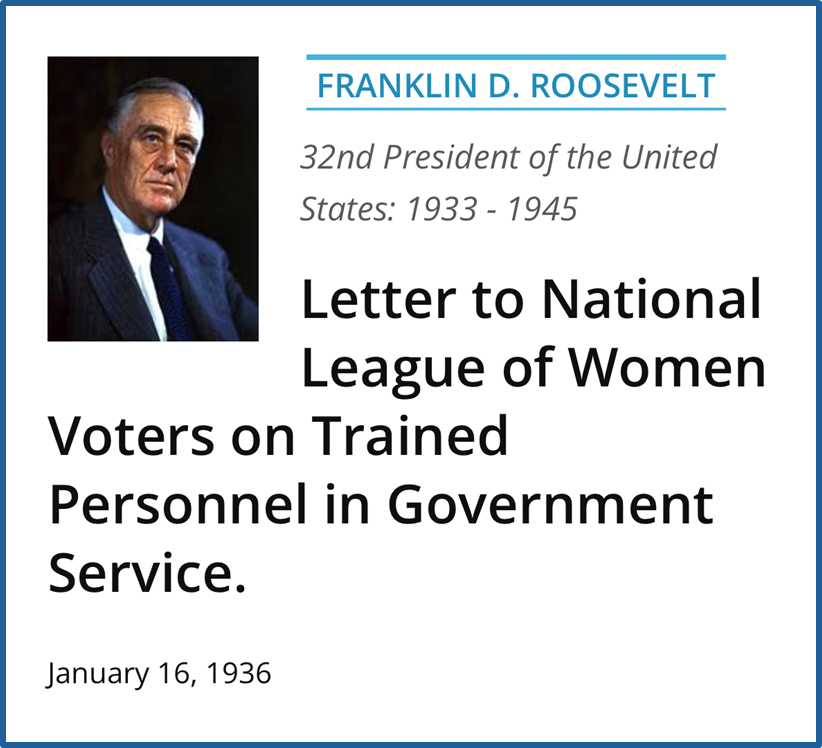
President Franklin D. Roosevelt himself commended the League’s work in a letter, writing:
“The National League of Women Voters has chosen wisely in conducting a campaign for securing trained personnel in the Government service through the open competition provided only by the merit system; and I am glad to assure your great organization of my support in this effort.”
Thanks in part to sustained advocacy by the League:
- Legislation passed in 1938 and 1940 removed hundreds of federal jobs from the patronage system and placed them under Civil Service protections.
- The League helped institutionalize the principle that public service should be nonpartisan and professional; a belief that underpins modern civil service systems.
Louisiana’s Unique History with the Civil Service
The dangers of politicized government were not limited to the federal level. In Louisiana, the Huey Long era offered a stark reminder of how civil service could be corrupted. Long built a vast political machine in the 1920s and 1930s, filling state jobs with loyalists and using public resources to cement his power. Louisiana’s eventual move toward civil service protections in the mid-20th century was, in part, a response to this abuse of power.
In Conclusion
LWVUS was an early and influential advocate for civil service reform, particularly during the 1930s and 1940s. Its efforts:
- Helped move hundreds of federal jobs into the merit system, shielding them from political interference.
- Earned praise from President Roosevelt for advancing nonpartisan, professional government.
- Reinforced lessons from state experiences like Louisiana’s, where unchecked patronage fueled the rise of a demagogue.
As history shows, when public service becomes politicized, democracy itself is at risk. The League’s century-long commitment to civil service reform remains vitally important today, at a time when conditions are again ripe for demagoguery and the erosion of professional governance.